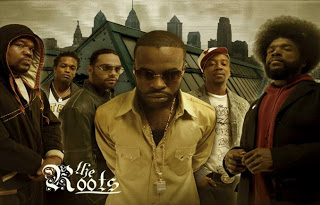
Spotlight: The Roots

If you’ve never heard of them like that, then it’s your fault, not theirs. See they’ve always been around- well, at least since 1993. They are one of the more- if not the most- underrated bands of their time. Who am I talking about? Well, none other than, The Roots- an 8-man Hip Hop band (that’s right, I said it, band), hailing from the great “City of Brotherly Love”- Philadelphia. Formed in 1987 by members Ahmir “Questlove” Thompson & Tariq “Black Thought” Trotter, The Roots have consistently put out groundbreaking and innovative music since the release of their 1st album, 1993’s, Organix! They have worked with a slew of other artists, from either a performing, recording, or production standpoint. Now with the two original members being in their early-forties, they have put out a total of 10 albums- both refining and defining their sound more and more as each year progresses.
Questlove and Black Thought met at Philly’s esteemed “High School for The Creative and Performing Arts, where they attended with classmates such as Boyz II Men and Neo-Soul goddess, Amel Larrieux. Originally calling themselves “The Square Roots,” the duo formed a Drummer/MC combo, and began performing around spots in Philly, such as South Street, and various talent shows in the area. They soon rounded out their act by adding a bass player, a keyboardist, and a second MC to complete their sound. They soon shortened their names to “The Roots” and independently released their 1st album, Organix! to industry acclaim in 1993. Over the next few years, the band signed to DGC records and released Do You Want More(1995), Illadelph Halflife (1996), and Things Fall Apart (1999). The begin to receive more mainstream success by collaborating with Raphael Saadiq on 1996’s “What They Do,” & 1999’s “You Got Me,” featuring Erykah Badu. They became more experimental in both their approach and artistic content, making their videos offbeat, engaging, and sometimes controversial. In the video for “What They Do,” they made it a point to poke fun of all the Hip-Hop video stereotypes of the day, including rappers glorifying sex, “showing off” how much money they have, and the usual “on-location” shots of ‘the hood.’ With 1999’s “The Next Movement,” from the album,Things Fall Apart, its infectious groove, and bass-driving beat all throughout the song made it an instantaneous underground hit. The video just consists of the band playing in a room with no furniture whatsoever- but from all different angles, upside down, sideways, etc.
Then came 2002’s Phrenology, the next chapter in The Roots’ ever-evolving sound. This album included numerous contributions from other Neo-Soul and Hip-Hop artists such as Musiq Soulchild, Jill Scott, and Talib Kweli. By this point, the band was incorporating everything from Funk- to-Jazz- to- Rock as part of their musical unit. The latter being most evident with the track, “The Seed 2.0” featuring Cody ChestnuTT; a psychedelic soul/rock-infused masterpiece that many considered to be one of the album’s best tracks. It was also around this time that Questlove began to work on a side project called, “The Soulquarians”- a “neo soul and hip hop informed musical collective” that produced and performed on many of the most popular neo-soul and hip-hop recordings of the day, such as D’Angelo’s Voodoo (2000), and Common’s Electric Circus (2003). The tribe consists of Questlove, Bilal, Common, Erykah Badu, D’Angelo, Mos Def, Q-Tip, James Poyser, Pino Palladino, and Talib Kweli.
Over the next 10 years, The Roots released a host of other albums to critical acclaim including 2004’sThe Tipping Point, 2006’s Game Theory, 2008’s Rising Down, 2010’s How I Got Over, & 2011’s Undun. When they are not busy with being the house band for the talk show, “Late Night with Jimmy Fallon,” they are consistently touring, recording, producing hits for other artists, and performing to sold-out crowds around the world. Even though they have not received nearly the accolades they deserved in an astonishing, almost 20-year career, for going against the grain and refusing to sound like anyone else; they have certainly managed to solidify their place in not only Hip-Hop, but music history.